Tuesday, 8 November 2016

ABOUT COMMON VITAMINS: VITAMIN B17

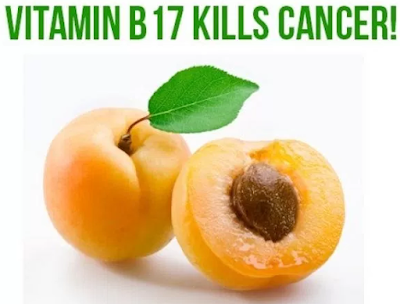
Nitrilosides. Amygdalin. Known as Laetrile when used in medical dosage form. Measured in milligrams (mg.).
Functions
Specific preventive and controlling anti-cancer effect, as proposed by its discoverer,
Deficiency symptoms

Prolonged deficiencies may lead to diminished resistance to malignancies.

Natural sources

Most whole seeds of fruits and many grains and vegetables, such as apricot, peach and plum pits;

apple seeds;

raspberries, cranberries, blackberries and blueberries; mung beans, lima beans,

garbanzas;

millet, buckwheat and flaxseed.

MDR (minimum daily requirement):
Vitamin B17 is not accepted officially as a vitamin, and, thus, no need in human nutrition has been established. Therapeutic doses are determined by doctors who use it in cancer treatment. If apricot and other fruit pits are included in the diet for preventive purposes they should be used only in small amounts, only a few pits a day. It is considered that if the diet contains an abundance of whole seeds, grains, nuts, beans and other foods mentioned above, deficiency of this factor will be unlikely.

SURGICAL TREATMENT FOR WEIGHT LOSS

Methods of surgical treatment

History is littered with unsuccessful procedures intended to cause weight loss:


No further surgical treatment of obesity has apparently been attempted since the tragical fate of a German Duke who in order to get leaner had the fat cut away by a Doctor in Upper Italy, and naturally succumbed to the operation (manuscript communication from Professor Dr DeLagarde 23 February 1882)

Other obsolete methods of surgery include jejunoileal bypass and jaw wiring, both of which are described later in this chapter.

There are two commonly used categories of bariatric surgery – restrictive and malabsorptive – and these are used either alone or in combination. More recently, implantable gastric pacing devices have been introduced.

Surgical treatment of obesity is a vital facet of weight management and, in many, patients is the only effective method for losing weight. As in every other branch of surgery there have been massive technological advances in surgical procedures, resulting in safer, better and cheaper operations. The surgical option is limited to a few extremely obese people but for such patients it is an important means of significant long-term weight loss, and a huge improvement in health and quality of life.

FIGHT CANCER OUTSIDE THE PROSTATE

Studies have found that men with higher tumor stage and grade were more likely not to be cured by radiation seeds (which makes sense, considering that most implantation programs don’t do anything to fight cancer outside the prostate).

 Also, some studies have found that a significant number of men—20 percent in one study—who got radioactive iodine implants required radical prostatectomy to help fight cancer that had returned. With external-beam radiation therapy, this number is much lower, about 8 percent. (Note: Many urologists feel that radical prostatectomy after any radiation treatment is not going to be very successful and will not perform the operation on these men.)

And in studies comparing seed implantation’s results in controlling cancer to other therapies, the seeds have come in a distinct third to radical protectorate and external-beam radiation therapy. In no major study has interstitial brachytherapy ever proved a better method than the other two main forms of treatment for prostate cancer. However, many studies looking at “relapse-free survival” have shown, at ten years after seed implantation, that 58 percent or more of men are still alive and cancer-free, and one study found that 53 percent of men who didn’t have cancer in the lymph nodes were alive and cancer-free after fifteen years. The bottom line from a host of studies seems to be that seed implantation—if it doesn’t ultimately cure prostate cancer—can at least delay it significantly, for years.

Thursday, 3 November 2016

HETEROSEXUAL OFFENDERS VS. ADULTS: AGE OF COITAL PARTNER

In studying the ages of the companions with whom the offenders vs. adults first had coitus, we see that for only a moderate number the girls were thirteen or younger; for 29 per cent the girls were fourteen to fifteen, for 28 per cent, sixteen to seventeen, and for 21 per cent eighteen to twenty. In the next age-category, that of women twenty-one and over, the offenders vs. adults plummet to the bottom of the rank-order with only 11 per cent of their members having had their first coitus with females who had attained legal age.


 This drop does not reflect any marked age preference, but is chiefly the result of the fact that nearly all of the offenders vs. adults had had coitus before they were twenty-one; there were very few virginal offenders vs. adults left to have coitus with women their own age or older.

A direct question regarding age preference revealed only a moderate predilection for girls aged sixteen to seventeen. The fact that 16 per cent (fifth in rank-order) of the offenders vs. adults at the time they were interviewed (and the average age then was nearly thirty) preferred girls aged sixteen to seventeen does indicate an above-average though not extreme desire for youth. Note that only 8 per cent of the control group shared this preference. Obviously, while the majority of offenders vs. adults may not have preferred girls of sixteen to seventeen, they did find them quite acceptable as coital partners, as is demonstrated by the fact that about three fifths of the “victims” were girls of that age.

Wednesday, 2 November 2016

GROWING OLD

What is growing old, anyhow? A half century ago, people thought that the most obvious aspects of growing old—senility, strokes, heart disease, and cancers—were part of the natural process of aging. Now we recognize that they may often be wreckage from our collisions with the microbial world. If most microbes deal with us benignly, then we are compelled to ask how much of the less obvious part of aging is caused by microbial fender benders. Logic tells us that it may be much. If so, what can we expect from human life simply by preventing the damage from our encounters with microbes?

The diversity of activity among the elderly gives us a clue. The bodies of some 50-year-olds are falling apart, whereas some people pushing 80 seem to be cavorting like teenagers. I know this from personal experience because my mother, Sara Jeanne Ewald, is one of these teenagers in her late 70s. She does not respond in ways typical of a person of this age group. For instance, she was run over by a truck in November 1998 and brought to the hospital with a badly fractured pelvis, a broken set of ribs, and a punctured lung. She left the hospital in December and was walking with a cane in January. In April she discarded the cane and departed on a European tour with her boyfriend, leaving in her wake doctors and nurses who were happily scratching their heads in disbelief.

Could the recovery rate from such injuries depend on whether someone was lucky enough to be resistant to chronic infections? I don’t know. Many of the elderly and some middle-aged people have problems with osteoporosis; if infections play a role in this condition, then an elderly person who is resistant to such infections might be especially well able to heal broken bones. Sara Jeanne has been incredibly resistant to acute infectious diseases throughout her eight decades of life. “I must have a strong immune system,” she would often say to me as I was growing up. Perhaps that may help explain why she is zipping around like a college student on spring break instead of being hobbled by the ailments of old age.

Of course this account is just an anecdote. But what is an anecdote? In an effort to be scientifically rigorous, twentieth-century medical science has made anecdote a dirty word. Ardent attempts to codify rigor have stripped us of the benefits anecdotes provide. Anecdotal observations are essential for rigorous science because they provide possible clues to the solution of medical puzzles. Their true value often cannot be discerned without follow-up studies. They may turn out to be junk or gems. When anecdotal observations are followed up with careful studies, some will be recognized as spurious coincidences, whereas others will be recognized as the signposts that guided research to new breakthroughs.

The vision of medicine is sometimes blinded by the average. Any large cohort of 80-year-olds will include some who are youthfully active and others who have become immobilized by the “process of aging.” We see the same in 70-year-olds and 60-year-olds. But as the cohort becomes younger, our sense of what is normal changes. We begin to see the debilitation as something out of the ordinary and therefore deserving of a special explanation. We therefore begin thinking of the debilitation as disease rather than as part of the normal process of aging. Once this transition in thinking occurs, we are spurred to understand the cause of the illness. Perhaps when we understand the full scope of infectious causation and effectively prevent its damaging outcomes, vibrant 80-year-olds will be the rule rather than the exception.

PROSTATE CANCER: THE VERY UNDERSTANDABLE PROBLEM

The very understandable problem most people have in accepting this approach is the uncertainty associated with it. What is my cancer going to do? Will it just sit there for years, or will it begin to spread quickly? And, the biggest worry of all, how long have I got to live? Am I going to die soon?


No doctor can answer these questions, because in every man, prostate cancer is different. However, although we don’t know the absolute answers for your specific cancer, we do know some things, and they are reassuring.

We know what generally happens to men in your situation who are followed carefully with watchful waiting: Gradually, over time, the PSA level will go up. At some point, the bone scan will become positive. This is the time to begin hormone therapy. Once hormone treatment is under way, the PSA level almost always falls dramatically and stays low indefinitely—for some men, this can mean many years. However, at some point down the road, if the patient lives long enough, the PSA will begin to rise again, as the hormone-resistant cells start to multiply. This is when both patients and their physicians begin to worry, because if these cells cannot be stopped, a man’s lifespan is generally only one or two years from this point.

Now, having said this, we also add that for men facing this today, there is great hope. Within the next five to ten years, we expect major new advances that will make it possible for us to control these hormone-resistant cells. Monumental research efforts are being focused on finding new and better ways to treat advanced prostate cancer. And it is entirely possible, if and when you ever reach the point where the hormonal therapy is no longer working, that more effective treatments will be there waiting for you.

Therefore, it is impossible to tell any man with prostate cancer how long he will live today because there is great and reasonable hope that he will have a much brighter outlook tomorrow.

So, to sum up: All of this means that if you have positive lymph nodes and embark on a plan of watchful waiting, you will be avoiding unnecessary side effects today from treatments that will not prolong your life; that these treatments will be there tomorrow, if you develop symptoms and need them. And that, in the future, there is a strong likelihood that we will have new treatments available for you that will do a better job of controlling this cancer.

Tuesday, 1 November 2016

HORMONE COMBINATIONS AND SINGLE-DRUG FORMATS: WHAT STAGE ARE YOU AT?

If you are having irregular, heavy and prolonged menstrual periods and distressing menopausal symptoms

Your hormone therapy options include the following:

- HRT pill that combines oestrogen and progestogen

- natural oestrogen daily plus progestogen for ten to fourteen days a month

- low-dose combined Pill for women needing contraception

- the synthetic oestrogen ethinyl oestradiol, in combination with the progestogen-like substance cyproterone acetate (the combined formulation Diane-35) if acne and worrisome hair growth are problems and contraception is also needed

If you are postmenopausal and have a uterus

Your options for hormone therapy include the following:

- natural oestrogen pill daily or continous oestrogen by patch or implant, teamed with progestogen for ten to fourteen days a month (combined cyclical therapy)

- continuous natural oestrogen and continuous progestogen (continuous combined HRT)

The first of these approaches usually causes monthly withdrawal bleeds that become lighter after a few months and may continue for however long you use HRT. With the second approach, irregular bleeding may occur for the first few months but most women no longer have any bleeding a year later.

If you are postmenopausal and do not have a uterus

Your options for hormone therapy include the following:

- natural oestrogen by pill daily or continuous oestrogen by patch or implant

- natural oestrogen daily and low-dose progestogen daily (for about six months immediately after surgery for endometriosis)

- oestrogen with or without testosterone implants